Sex coach certification is professional training in sexology, coaching methodology, and ethics that prepares someone to work with clients on sexual wellbeing in a structured, accountable way. Because sex coaching isn't a licensed profession in most countries, certification, not a government license, is what establishes a practitioner's credibility and competence.
If you're researching how to become a sex coach, here's the detail that matters most: there's no single licensing exam standing between you and the title, which means the program you choose carries more weight than it would in a regulated field. This guide walks through what certification actually involves, what a credible program should cover, and what completing one at Sex Coach U specifically looks like, including cost, curriculum, timeline, and what you walk away with.
What Is Sex Coach Certification, Exactly?
Sex coach certification is a structured training program, typically combining sexology education, coaching skill-building, and supervised practice, that prepares a practitioner to support clients with sexual wellbeing, communication, and intimacy concerns. It results in a professional credential, not a government license, since most countries have no licensing body specific to sex coaching.
Sex coaching combines two disciplines: sexology, the study of what people do sexually and how they think and feel about it, and coaching, a forward-focused methodology built around a client's own goals rather than a clinician's diagnosis.
The profession builds on clinical sexology research going back to the 1960s and 70s (Masters and Johnson, Helen Singer Kaplan), alongside the human potential movement and the rise of coaching psychology. Certification is what turned that combination into something teachable and assessable, rather than a loose set of ideas.
For a deeper look at what the discipline itself involves day to day, see What Is Sex Coaching?
Do You Need a License to Become a Sex Coach?
No. Sex coaching is not a licensed profession in most countries, meaning there's no government exam or regulatory board governing who can use the title. That makes certification, not licensure, the meaningful credential, and the rigor of the certifying program is what actually protects clients and establishes a practitioner's legitimacy.
That absence of regulation cuts both ways. It's part of why sex coaching as a career is accessible to people from many professional backgrounds (therapists, nurses, educators, career-changers) without years of clinical licensure first. It also means the burden of quality control sits entirely with the training itself, since there's no exam afterward to catch gaps.
A credible program reflects that responsibility in its structure: defined scope of practice, referral protocols for when a client's needs go beyond coaching, and supervised practice rather than self-paced reading alone. Sex coaches also work talk-only, meaning sessions don't involve physical contact with clients, which is itself part of how the field defines its scope.
How Is Sex Coach Certification Different From Therapy or Counseling Training?
Sex coach certification trains a different skill set than therapy or counseling licensure. Therapy is a licensed practice focused on diagnosing and treating mental health conditions. Counseling is a licensed practice focused on present-day emotional challenges and life transitions. Coaching is certified rather than licensed, and forward-focused, partnering with a client on their own goals rather than treating a diagnosis.
All three exist to help people create change, but they differ in approach and authority. A sex coach is trained to recognize when a client's needs are better served by a therapist or counselor, for example trauma, clinical-level anxiety, or a condition that needs diagnosis, and to refer out rather than attempt to treat it. That referral judgment is itself part of what certification is meant to teach.
This distinction is covered in more depth here: Sex Coaching vs. Sex Therapy.
What Should a Sex Coach Certification Program Actually Cover?
A credible sex coach certification program should cover sexology foundations (anatomy, arousal, desire, relational dynamics), coaching methodology (active listening, goal-setting, powerful questioning), ethics and scope of practice, a structured process for examining the practitioner's own values around sexuality, and supervised practice, rather than self-paced reading alone.
- Sexology foundations: how arousal, desire, and sexual function actually work, across life stages and circumstances.
- Coaching methodology: the skills that make coaching different from advice-giving, including deep listening, goal-setting frameworks, and powerful questioning.
- Ethics and scope of practice: clear boundaries, referral protocols, and informed consent.
- An attitude-examination process: most established programs include some version of a Sexual Attitude Reassessment (SAR), an experiential process for surfacing a practitioner's own biases before they show up in a session.
- Supervised practice: live or recorded practicum sessions with feedback, not just coursework.
- Business foundations: increasingly part of comprehensive programs, since most sex coaches build independent practices rather than joining an existing clinic.
See Sex Coach U's training overview for how this maps onto a specific curriculum.
What's Inside Sex Coach U's Certification Program?
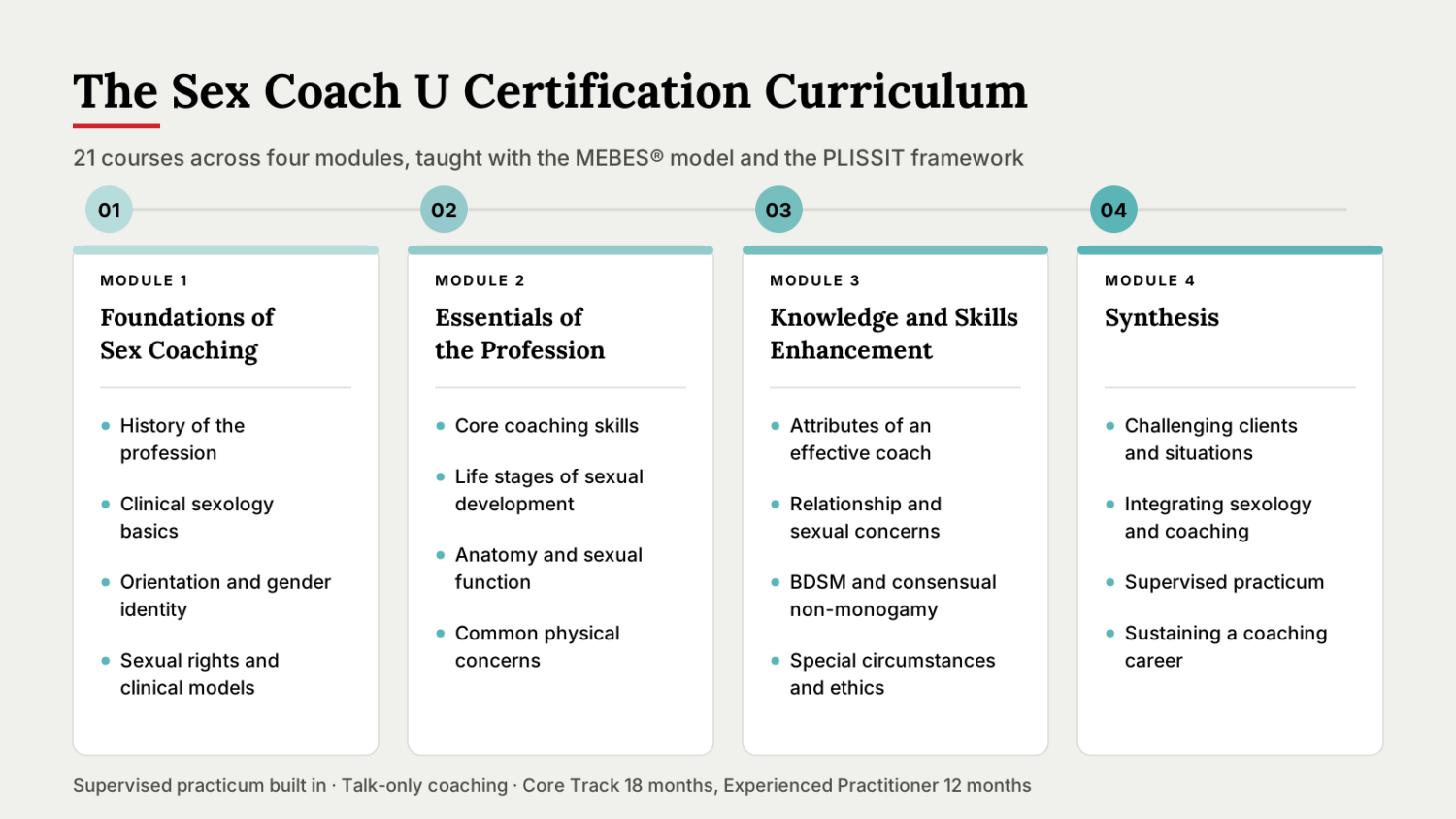
Sex Coach U's certification program includes 21 courses organized into four modules (sexology foundations, coaching essentials, applied skills, and practical synthesis), taught alongside the MEBES® model and the PLISSIT coaching framework, with supervised practicum sessions built in.
The four modules
Foundations of Sex Coaching: the history of the profession, clinical sexology basics, sexual orientation and gender identity, sexual rights, and the clinical models the field draws on.
Essentials of the Profession: core coaching skills, the life stages of sexual development, sexual anatomy and function, and common physical sexual concerns.
Knowledge and Skills Enhancement: the attributes of an effective coach, relationship and sexual concerns, topics including BDSM and consensual non-monogamy, special circumstances such as pregnancy, disability, and medical conditions, and ethical standards.
Synthesis: working with challenging clients and situations, integrating sexology with coaching practice, a supervised practicum, and sustaining a coaching career without burning out.
The MEBES® model was developed by Dr. Patti Britton, co-founder of Sex Coach U and author of The Art of Sex Coaching: Expanding Your Practice, an early training text written specifically on sex coaching. PLISSIT (Permission, Limited Information, Specific Suggestions, Intensive Therapy) was created by Jack Annon in 1976 and adapted into the program as a coaching framework. Training throughout is talk-only: coaches do not have physical contact with clients, and are trained to work alongside gynecologists, urologists, and therapists as part of a broader care ecosystem rather than in isolation.
For a closer look at what a sex coach actually does session to session, see What Does a Sex Coach Do?
What Do Sex Coach Certification Tracks Cost?
Sex Coach U's certification tracks cost $10,497 for the Core Certified Sex Coach™ Track (or $597 a month over 18 months, including business training), and $6,997 for the Experienced Practitioner track (or $597 a month over 12 months), aimed at already-licensed professionals adding this specialization. The standalone BOSS business program costs $3,397 separately, or comes included at no extra cost within the Core Certified Sex Coach™ Track.
| Core Certified Sex Coach™ Track | Experienced Practitioner | BOSS (add-on or standalone) | |
|---|---|---|---|
| Cost | $10,497 or $597/mo × 18 mo |
$6,997 or $597/mo × 12 mo |
$3,397 or $297/mo × 12 mo |
| Coursework | 21 expert-led courses plus full BOSS business training | 21 self-guided courses (prerequisites apply) | 13 project-based business courses |
| Timeline | 18 months | 12 months | 12 months |
| Best for | New entrants or professionals wanting full live support | Licensed therapists, counselors, psychologists, ICF coaches, healthcare providers adding this specialty | Coaches who only want the business training, sold separately (included free in the Core Certified Sex Coach™ Track) |
| Business training | Full BOSS included | Business Quickstart (BQS), with optional upgrade to full BOSS | This is the business training |
Experienced Practitioner applicants (therapists, counselors, psychologists, ICF-certified coaches, and healthcare providers working in sexuality-related fields) are asked to submit documentation of their existing credentials as part of the application.
Two costs sit outside tuition on either certification track: a Sexual Attitude Reassessment (SAR) seminar, which is required for certification and priced by the provider, and books and materials, typically under $300.
What Do You Receive When You Complete Certification?
Completing either of Sex Coach U's certification tracks (Core Certified Sex Coach™ Track or Experienced Practitioner) results in the Certified Sex Coach™ credential, eligibility to apply for Board Certified Sexologist status with the American Board of Sexology, and AASECT-approved continuing education credits (130 on the Core Certified Sex Coach™ Track, 106 on Experienced Practitioner). Certification also transfers toward a Master of Science in Sex Coaching at the International Institute of Clinical Sexology, covering up to half of the 60 credits required for the degree.
These outcomes are tied to the two sex coach certification tracks specifically. BOSS, taken on its own rather than as part of the Core Certified Sex Coach™ Track, is business training only: it doesn't include the sexology and coaching curriculum, so it doesn't lead to the Certified Sex Coach™ title, American Board of Sexology eligibility or the Master's credit transfer, although it does carry 72 AASECT CE credits of its own.
A few of these are worth being precise about. Sex Coach U is an AASECT-approved continuing education provider: program credits may be applied toward AASECT certification and its renewal, but completing the program on its own does not grant AASECT certification, which is a separate application through AASECT itself. Certified Sexologist status with the American Board of Sexology is an eligibility to apply, assessed by ABS on the basis of your training and background, not a credential conferred automatically at graduation. And the Master's transfer is set by IICS admissions on review of each applicant's record; admission to the degree requires a bachelor's degree or a professional license in healthcare, medicine, or mental health; a bachelor's degree in any field combined with Sex Coach U certification also qualifies.
Sex Coach U graduates are currently practicing in more than 85 countries. What that credential tends to translate into financially is its own question, with enough nuance to deserve a dedicated answer in a separate guide on how sex coaches structure their income and pricing.
Related reading: Careers in Sexuality: 11 Professional Paths.
Can SCU Certification Lead to a Degree?
Certification can also count toward a degree. Sex Coach U teaches a Master of Science in Sex Coaching, granted by the International Institute of Clinical Sexology (IICS) and studied online over 18 to 24 months. Sex Coach U certification counts toward up to 30 of the 60 credits required, and the degree opens a pathway to the Clinical Sexology PhD at IICS. Admission and credit transfer are decided by IICS. Full details, including tuition, are on the Master of Science page.
How Do You Apply for Sex Coach Certification?
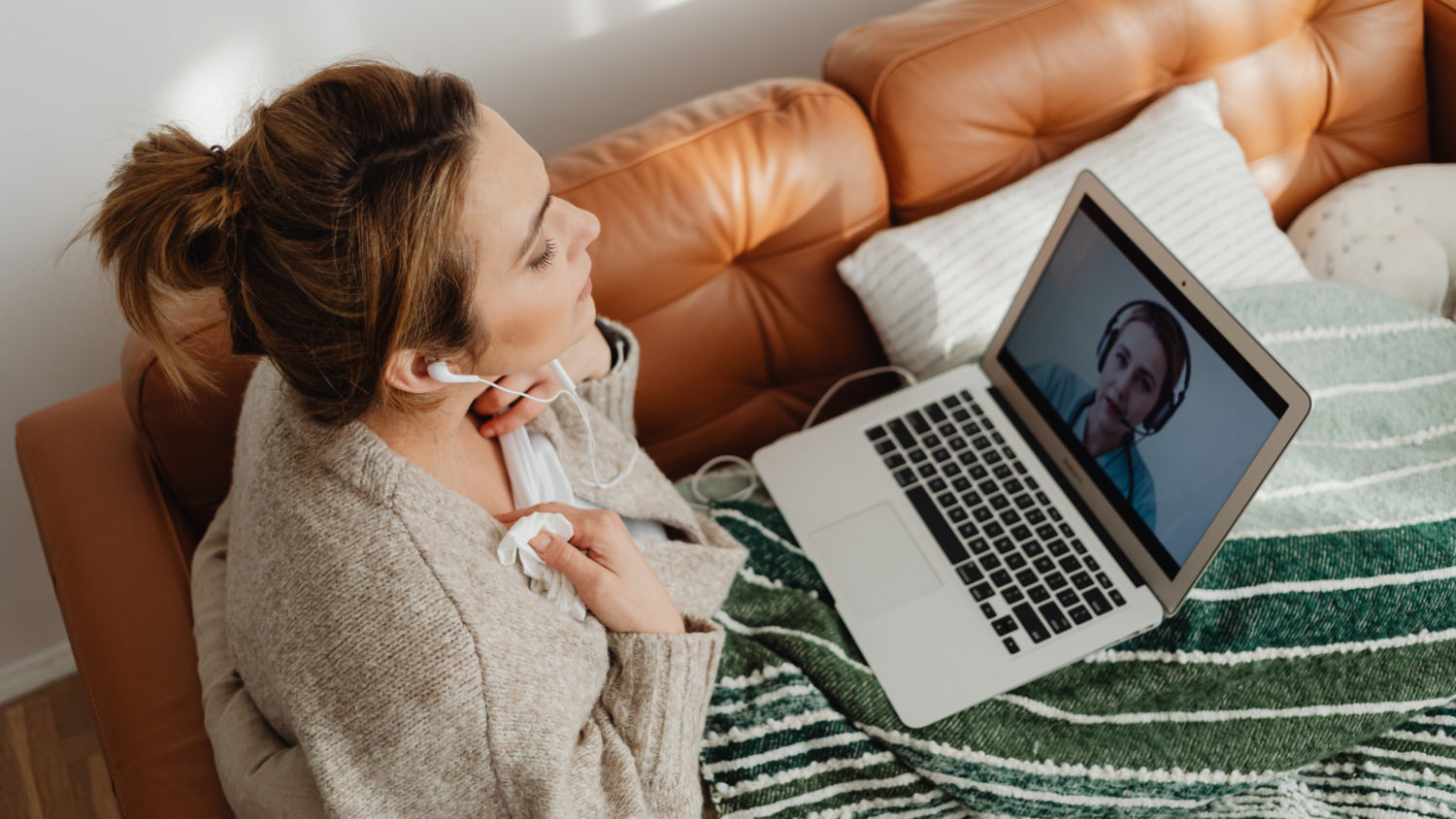
Sex Coach U's enrollment process runs through a written application, followed by an invitation to interview if the admissions team sees a good fit. Experienced Practitioner Track applicants submit documentation of their existing credentials at this stage. Accepted students move through onboarding, begin coursework on their cohort's start date, and meet fellow students and staff at a welcome webinar shortly after.
- Written application: submitted online. Experienced Practitioner applicants include supporting documentation of their existing license or certification.
- Application interview: with a member of the enrollment team, to discuss fit and answer questions.
- Acceptance: confirmed by email, followed by enrollment paperwork to finalize and secure your seat.
- Onboarding: student account setup and administrative steps.
- Welcome orientation: an introduction to staff and fellow students before coursework begins.
Cohort dates and seat availability change between application windows, so the specific calendar isn't reproduced here. Check the application page directly for what's currently open.
How Long Does Sex Coach Certification Take?
Timeline depends on the track. The Core Certified Sex Coach™ Track runs 18 months, with 10 to 15 hours a week of self-paced coursework plus live coaching labs and mentoring. The Experienced Practitioner track, built for professionals who already have one-on-one client experience, runs 12 months, with 10 to 12 hours a week of self-paced coursework plus live sessions. The standalone BOSS business program also runs a flexible 12-month path, at 4 to 6 hours a week.
All three are built around asynchronous, self-paced coursework at their core, with the difference coming down to how much live support and structured mentoring is layered on top: more in the Core Certified Sex Coach™ Track, lighter in Experienced Practitioner, which includes live webinars and peer community.
Is Sex Coach Certification Worth It?
Whether sex coach certification is worth it depends on what you're building toward. For professionals adding a specialization, or career-changers building an independent practice, certification provides the training, ethics, and credential that clients and referral partners look for, in a field with no licensing exam of its own. What you earn depends on business development as much as the credential.
That's a deliberately unglamorous answer, and it's the accurate one. A credential opens the door; building a sustainable practice on the other side of it is a separate skill, which is part of why business training is built into the curriculum rather than left as an afterthought.
FAQ
How much does sex coach certification cost?
Sex Coach U's two certification tracks range from $6,997 for Experienced Practitioner to $10,497 for the full Core Certified Sex Coach™ Track, both with monthly payment plans. The standalone BOSS business program, which doesn't carry a sex coaching credential on its own, costs $3,397 separately. Cost varies across the field generally depending on program length, how much supervision is included, and whether business training is bundled in.
How long does it take to become a certified sex coach?
At Sex Coach U, the timeline runs 12 months for the Experienced Practitioner and BOSS tracks, or 18 months for the full Core Certified Sex Coach™ Track. Programs built around self-paced coursework with optional live support let students move somewhat faster or slower depending on their own schedule.
Do you need a license to become a sex coach?
No. Sex coaching isn't a licensed profession in most countries, so there's no government exam required. Certification through a structured program is the professional standard in place of licensure.
What's the difference between a sex coach and a sex therapist?
A sex therapist is a licensed mental health professional who diagnoses and treats clinical conditions. A sex coach is certified rather than licensed, and works in a forward-focused way on goals, communication, and sexual wellbeing without diagnosing or treating pathology. The two refer to each other when a client's needs cross that line.
Can therapists, counselors, or coaches get certified faster?
Programs built for already-credentialed professionals, such as Sex Coach U's Experienced Practitioner track, offer a streamlined path that assumes existing client-facing skills. Applicants typically submit documentation of their existing license or certification as part of applying.
Is sex coach certification recognized internationally?
No single global accrediting body accredits sex coaching, so recognition depends on the certifying program's standing rather than a universal seal. Sex Coach U graduates currently practice in more than 85 countries, and the program is an AASECT-approved continuing education provider and a recognized educational institution with the American Board of Sexology.
Several members of SCU's teaching faculty also hold professorships in the Master of Science in Sex Coaching program at the International Institute of Clinical Sexology, so people who teach the subject at the graduate level also teach the certification.
The Bottom Line
Choosing a sex coach certification program comes down to the same questions you should ask about any unregulated profession: what the curriculum covers, who's teaching it, what credential you walk away with, and whether the structure matches how you learn. If you're weighing Sex Coach U specifically, full program details and current application steps are on the program page.